White-label client automation: one template, config per client
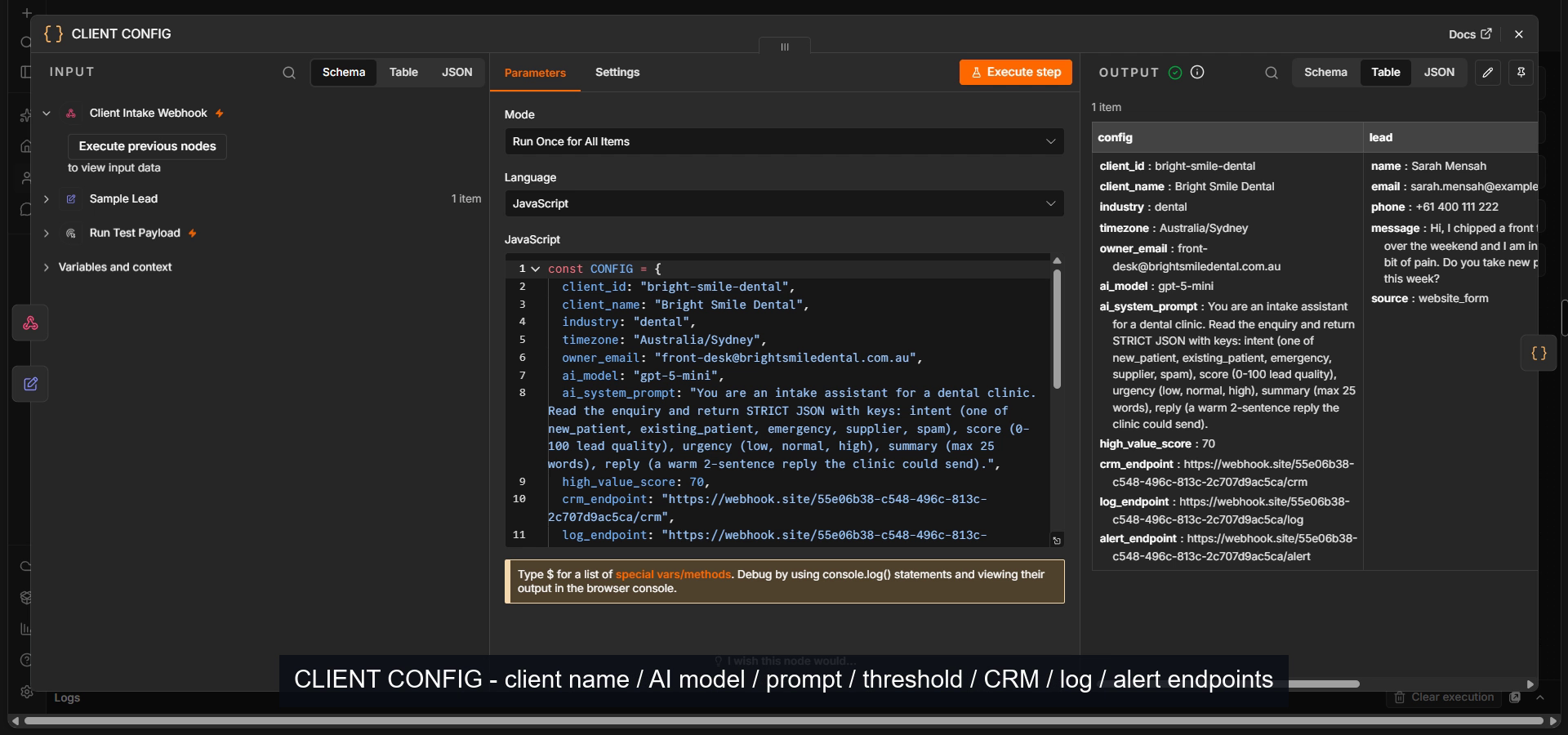
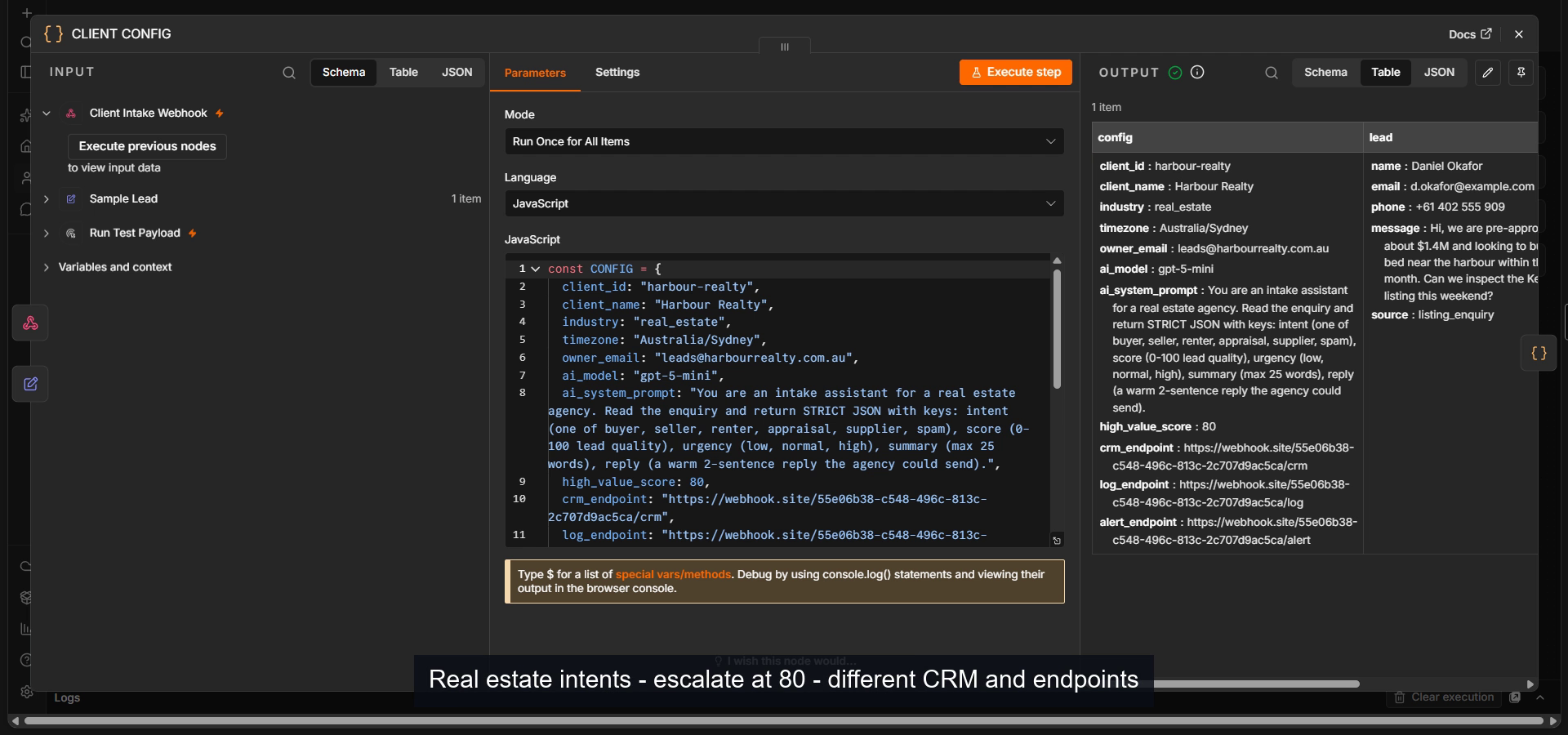
An n8n intake workflow built to be reused across clients. The nodes never change. The client's name, AI vocabulary, escalation threshold, CRM, logging and alert destinations all come from a single config node, so onboarding the next client is an edit rather than a build.
RECORDED DEMO · FICTIONAL CLIENTS
1. Onboarding client B
00:03 Dental clinic config swapped for a real estate agency. New vocabulary, new
threshold, new destinations, then the same pipeline handles a property enquiry.
2. Error handling
00:51 The AI step is pointed at a model that does not exist. Three retries, then the
error output fires, an alert goes out and the caller still gets a clean response.
3. Full walkthrough
01:30 Where config lives, credentials referenced not hardcoded, routing on the AI's
own classification, the test payload, and the audit row every run writes.
The entire onboarding, side by side
Client ADental clinic, escalation threshold 70
Client BReal estate agency, escalation threshold 80
What actually changes
| Config key | Client A | Client B |
|---|---|---|
| client_name | Bright Smile Dental | Harbour Realty |
| industry | dental | real_estate |
| ai_system_prompt | new_patient, existing_patient, emergency, supplier, spam | buyer, seller, renter, appraisal, supplier, spam |
| high_value_score | 70 | 80 |
| crm_endpoint | client A destination | client B destination |
| log_endpoint | client A audit log | client B audit log |
| alert_endpoint | client A alerts | client B alerts |
| nodes changed | none | none |
Why it is built this way
Config is data, not codeEvery client-specific value lives in one node.
Nothing about a client is spread through the workflow, so there is no hunt when something moves.
Two layers of error handlingCaught failures take the node's error
output, retry three times, then alert with the client name, failing node and execution id. Total
failures that kill the run are caught by a separate workflow-level trigger.
Credentials referenced, never hardcodedKeys live in n8n's credential
store. Moving the template to the client's own account does not mean editing the workflow.
A caught error still reports successn8n counts a handled failure as
a completed run, which is correct but misleading. That is why every run writes its own status to the
audit log rather than relying on execution status.
Both clients in this demo are fictional, and the CRM, logging and alert endpoints are throwaway test URLs, so the whole pipeline runs end to end without touching a real account. The AI step runs on a low cost model; for a production build it points at the client's own key, which is one line in the same config node.